The True Intrepid - Sir William Stephenson and the Unknown Agents by Macdonald Bill
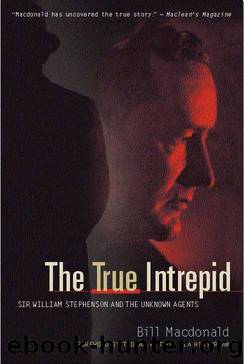
Author:Macdonald, Bill [Macdonald, Bill]
Language: eng
Format: epub
Publisher: True Intrepid
Published: 2011-08-18T16:00:00+00:00
15 Betty Raymond
In the 1930’s Betty Raymond worked in a rural English hotel doing secretarial work, when she was approached by her brother-in-law Francis Ogilvy about joining British Intelligence. Ogilvy, formerly with the Air Force, worked at Whitehall. He and Walter (Freckles) Wren were approached by their superiors in the intelligence community, who said they needed, “two or three women of education, who they could trust,” Raymond recalled, “who would be good with their hands.” She was interviewed by Frances Ogilvy and signed the Secret Service Act. “I said yes blindly and signed the lot.” One of her friends, Dorothy Hyde, joined about the same time. “That’s how they got Harford Hyde into it. Harford only came in because Dorothy was in it. But that’s how he came into it.”
Raymond began training soon afterwards and her manual dexterity was funnelled into intercepting mail and forgery.
She learned the unique craft from an elderly man named ‘Webb’, who began the art during the First World War. William ‘Steam Kettle Bill’ Webb devised a method of opening and then resealing envelopes without detection and controlled a large department in London. 453 “He was absolutely wonderful and he taught us. But it was really one of the things you had to learn after that from experience.” Years later when she returned to London, Raymond realized she was one of the few who could do all the various skills. Mail tampering had become compartmentalized. “Nobody was allowed to do them all. Typical. It was a rather civil servanty thing, you see. One could open some thing, and one could do another, and one could do another.”
Tampering with mail that couldn’t be detected was an acquired skill, rather than a formula. Some people were better at it than others, and improvisations could better the end product. Raymond says she and Hyde improved some aspects of what they were taught, but “dear old Mr. Webb”, the teacher, remained proficient. “All his work was very good. Chamfering for instance. If you opened a letter that you shouldn’t have opened. If you cut it open, then you had to put it back together again, as if nobody had opened it. This is a very difficult procedure which he originated. Called chamfering. It was not easy, but you could do it.”
After a relatively quick training period in Britain, Raymond and Dorothy Hyde were sent to a major mail intercept station located in Bermuda. Working behind locked doors, six to eight women toiled in their Hamilton section, covertly going through mail and packages sent to and from Europe and the Americas. With practice, both of the women became experts in opening and sealing mail without detection. “Harford always said that I was Dorothy’s assistant, but he didn’t know very much. We were totally different, but we were a very good team. Both Dorothy and I moved up to New York, you see.”
The process could be tedious, but occasionally their diligence was rewarded. In one instance an examiner had a hunch about a letter.
Download
This site does not store any files on its server. We only index and link to content provided by other sites. Please contact the content providers to delete copyright contents if any and email us, we'll remove relevant links or contents immediately.
| Africa | Americas |
| Arctic & Antarctica | Asia |
| Australia & Oceania | Europe |
| Middle East | Russia |
| United States | World |
| Ancient Civilizations | Military |
| Historical Study & Educational Resources |
The Radium Girls by Kate Moore(12028)
100 Deadly Skills by Clint Emerson(4926)
Rise and Kill First by Ronen Bergman(4789)
The Templars by Dan Jones(4689)
The Doomsday Machine by Daniel Ellsberg(4490)
The Rape of Nanking by Iris Chang(4213)
Killing England by Bill O'Reilly(4004)
Stalin by Stephen Kotkin(3968)
Hitler in Los Angeles by Steven J. Ross(3946)
12 Strong by Doug Stanton(3550)
Hitler's Monsters by Eric Kurlander(3343)
Blood and Sand by Alex Von Tunzelmann(3205)
The Code Book by Simon Singh(3189)
Darkest Hour by Anthony McCarten(3133)
The Art of War Visualized by Jessica Hagy(3008)
Hitler's Flying Saucers: A Guide to German Flying Discs of the Second World War by Stevens Henry(2754)
Babylon's Ark by Lawrence Anthony(2679)
The Second World Wars by Victor Davis Hanson(2526)
Tobruk by Peter Fitzsimons(2518)
